
Most business owners know they should have a CRM. This guide shows exactly what it is costing them every single month that they do not.
There is a moment every growing Canadian business owner recognises. You are juggling ten conversations in your head. Leads that called last week and you are trying to remember where you put that number. A follow up that was supposed to go out on Thursday. A quote for a client in Mississauga that you cannot find because it is buried in your email somewhere between three unread newsletters and a supplier invoice.
You are running your sales operation from memory, habit, and a combination of tools that were never designed to work together such as a Gmail inbox, an Excel spreadsheet, a WhatsApp group, and sheer willpower.
It works, sort of. Until it does not.
The question most business owners never get around to answering honestly is this. What is this actually costing me? Not in the abstract sense of we could be more efficient, but in real dollars, every month, that are leaving your business because of how you are managing your sales process right now.
That is what this guide is going to walk through. By the time you finish reading it, you will have a clear, numbers based picture of what running without a CRM is costing your Canadian business, and what getting the right system in place would actually change.
Section 01
The Hidden Revenue Problem That Nobody Talks About Openly
Canadian small businesses are, by almost every measure, under systematised when it comes to sales. A 2024 survey found that fewer than 35 percent of Canadian SMBs with fewer than 50 employees use a dedicated CRM tool. The rest are managing their sales pipeline through a patchwork of tools or not managing it at all in any structured sense.
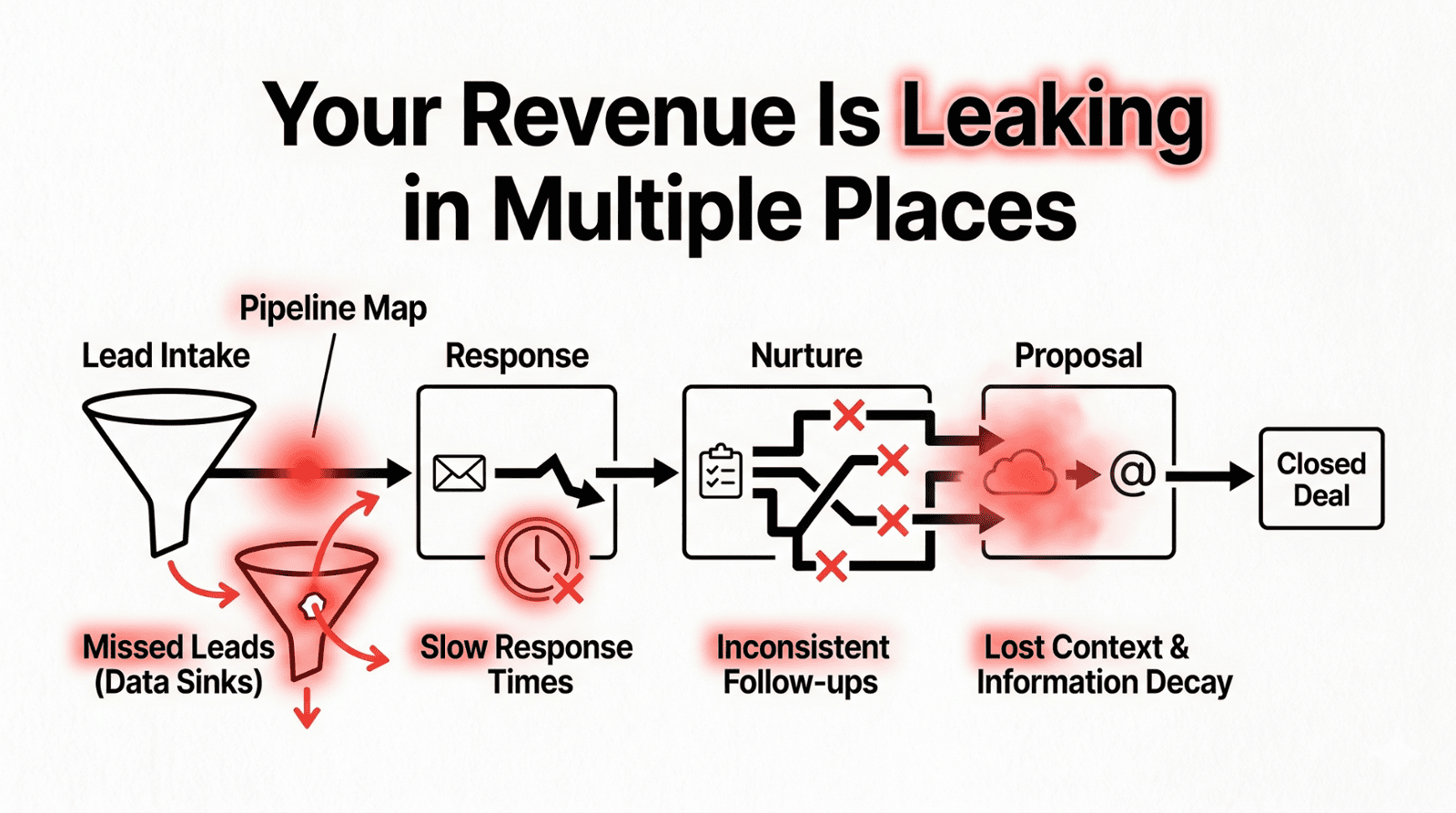
This is not because business owners do not care about sales. It is because the pain of not having a CRM is diffuse and gradual. Unlike a broken piece of equipment or a failed shipment, a leaking sales process does not announce itself with a loud bang. It bleeds quietly. A lead here, a deal there, a follow up that never happened, and the cumulative effect only becomes visible when you step back and look at the numbers honestly.
| Canadian SMB Sales Reality Check |
|---|
| Fewer than 35 percent of Canadian SMBs under 50 employees use a CRM. |
| The average sales rep spends 17 percent of their week searching for information they should have at their fingertips. |
| Businesses that follow up with leads within 1 hour are 7 times more likely to qualify them. |
| 78 percent of buyers purchase from the first company that responds to their enquiry. |
Section 02
The 6 Ways Your Business Is Leaking Revenue Right Now
Leak 1: Leads That Fall Through the Cracks
Every business loses leads. But without a CRM, businesses lose them systematically. When a lead enquires via your website form, sends a Facebook message, calls your office, and emails your general inbox all in the same week, how confident are you that all four touchpoints are being tracked, attributed, and followed up on by the same person with full context?
In practice, without a CRM, the answer for most businesses is not very. Leads fall through because website form submissions go to an email inbox that three people share but nobody owns. A lead that called on Friday gets forgotten over the weekend because there is no task created. A referral lead mentioned at a networking event never makes it into any system because there was no process to capture it. Duplicate enquiries from the same prospect create confusion about who is responsible.
Let us put a number to this. If your business generates 80 leads per month and you conservatively estimate that 15 percent fall through the cracks due to process failure, that is 12 lost leads every month. At an average Canadian SMB deal size of $8,000 CAD and a 15 percent close rate on properly followed up leads, those 12 lost leads represent roughly $14,400 CAD in lost potential revenue every single month.
Leak 2: Slow Lead Response Time
Speed of response is one of the most heavily researched factors in sales conversion, and the data is unambiguous. Leads that are contacted within the first hour of enquiring are significantly more likely to convert than leads that are contacted the following day.
Without a CRM, lead response time depends entirely on whether the right person happened to see the enquiry at the right time. With a properly configured CRM, new leads trigger an immediate automated acknowledgement plus an assigned task for a salesperson with a four hour response window. The system eliminates the variability that kills conversion rates.
In the Canadian market specifically, where many SMBs are competing in the same local territory, the difference between a one hour response and a next day response is often the difference between winning and losing the deal. Buyers enquiring from multiple suppliers simultaneously will often commit to the first credible response they receive. Businesses that respond to leads within one hour convert at rates up to 391 percent higher than those that respond the following day. This is not a marginal improvement. It is a structural difference in conversion performance driven entirely by process, not by sales skill.
Leak 3: Inconsistent Follow Up
The follow up is where most Canadian SMB deals are lost, not in the initial conversation, but in the silence after it. Research consistently shows that the majority of sales require between five and eight follow up touches before a prospect makes a decision. Most salespeople without a system stop after one or two.
Not because they are bad at sales, but because they have no reliable process reminding them to follow up, no visibility into which prospects need attention, and no way to manage ten active conversations simultaneously without dropping some.
A CRM solves this structurally. Automated follow up sequences ensure that every lead receives the right number of touches at the right intervals, regardless of how busy the salesperson is. Tasks are created automatically. Reminders fire when a prospect has gone quiet for too long. Nothing falls off the radar. Without this structure, your business is relying on your salespeople's memory and discipline to manage a process that, statistically, requires consistency across eight or more touchpoints. Some deals will get followed up excellently. Others will get one email and a phone call that was never returned, and then be forgotten.
| Follow Up Touches | Close Rate Without CRM | Close Rate With CRM Automation |
|---|---|---|
| 1 touch | 2 percent | 2 percent |
| 2 touches | 3 percent | 5 percent |
| 5 touches | 10 percent | 18 percent |
| 8+ touches | 12 percent | 27 percent |
Leak 4: Lost Context and Repeated Conversations
There is nothing more damaging to a customer relationship than making them repeat themselves. When a prospect who called three weeks ago, spoke to your salesperson for twenty minutes about their specific situation, and was told someone would follow up, then receives a follow up call that opens with asking to remind them what they were looking for, the damage to trust is immediate and often irreversible.
Without a CRM, sales context lives in individual people's heads, their personal email inboxes, and their handwritten notes. When a salesperson is sick, on vacation, or leaves the company, that context disappears entirely. The customer has to start from zero with whoever picks up the file, if anyone does. The cost of this is not just lost deals. It is the cumulative erosion of your reputation as a business that takes its customers seriously. In a country where word of mouth referrals remain one of the top drivers of new business for Canadian SMBs, that reputational cost compounds over time.
Leak 5: No Visibility Into What Is Actually Working
If you cannot measure your sales process, you cannot improve it. And without a CRM, measurement is almost impossible at any meaningful level of detail. Questions that a CRM answers in thirty seconds, and that take hours to approximate without one, include knowing which lead source is generating the most revenue, what your average deal cycle time is from first contact to close, and which salesperson has the highest conversion rate.
Without answers to these questions, every sales decision is based on gut feel and anecdote. You invest more in the marketing channel that feels like it is working, not the one that demonstrably generates the highest revenue. You promote the salesperson who seems the most active, not the one whose conversion data shows the most consistent performance. Every decision carries more risk than it needs to.
Leak 6: Admin Time That Should Be Selling Time
A salesperson spending significant time on administrative work is a salesperson not selling. Without a CRM, the administrative overhead of managing a sales pipeline manually is substantial. This includes manually logging call notes into a spreadsheet after every conversation, manually creating follow up reminders in a calendar or task app, manually generating quotes by copying client details from emails into a Word template, manually updating a pipeline spreadsheet that is always out of date, and searching through email threads to find what was promised to a client three weeks ago.
Industry research suggests that sales reps in non CRM environments spend an average of 17 percent of their working week on these kinds of administrative tasks. For a salesperson working 45 hours per week, that is approximately 7.5 hours of selling time lost every week to administrative work that a CRM would automate entirely. At a loaded cost of $35 per hour for a mid level Canadian salesperson, that is roughly $13,650 CAD per year, per salesperson in time cost alone, before you count the revenue impact of the selling they are not doing during those hours.
Section 03
Your Personal Revenue Leak Estimate
Let us pull all of these numbers together into a framework you can apply to your own business. Use these conservative estimates as a starting point. The real numbers for your business may be higher or lower depending on your deal size, lead volume, and team size.
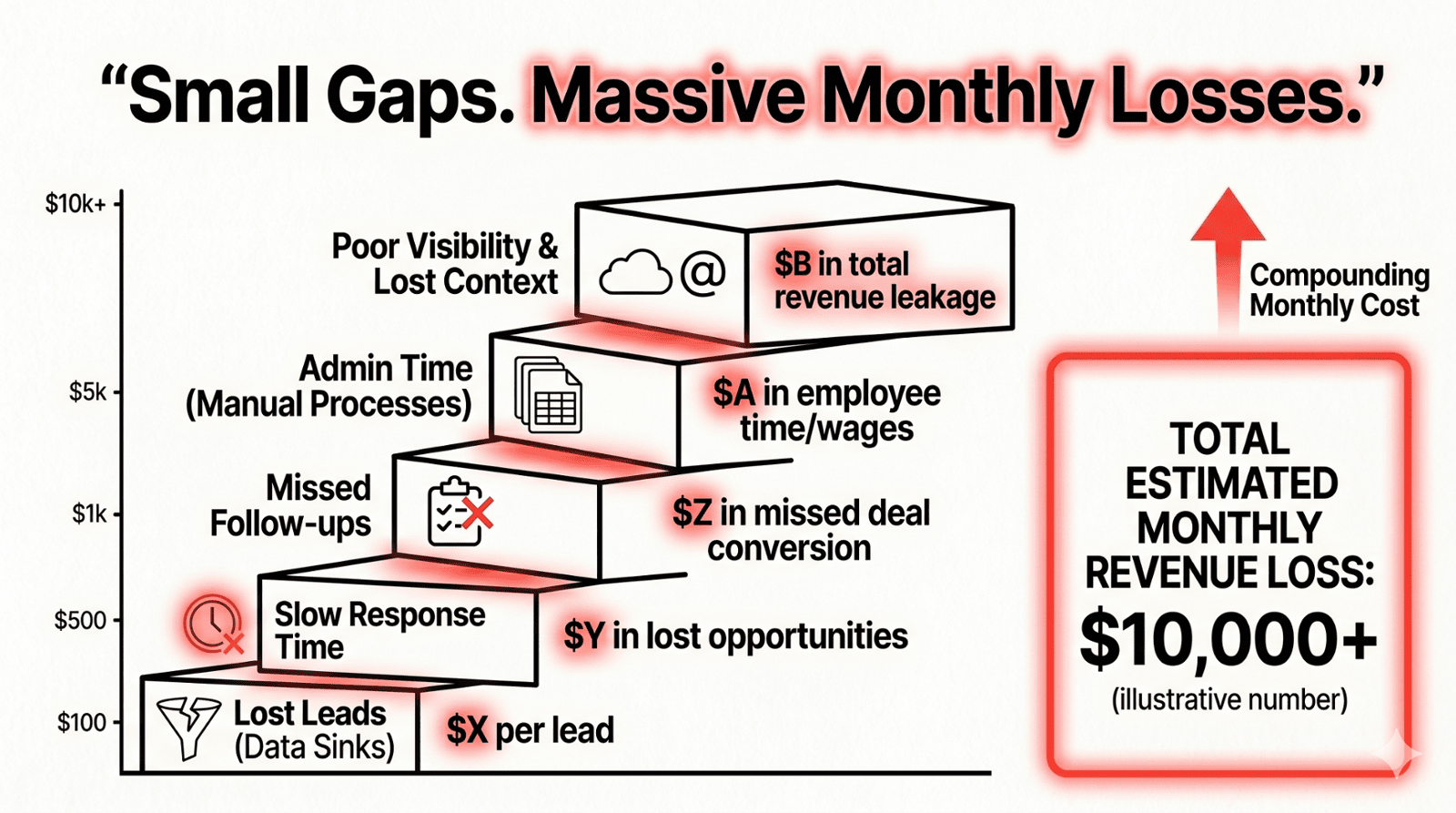
| Revenue Leak Source | Conservative Monthly Estimate |
|---|---|
| Lost leads (15 percent slip rate) | $8,000 to $18,000 CAD |
| Slow response time cost | $3,000 to $9,000 CAD |
| Inconsistent follow up | $5,000 to $15,000 CAD |
| Admin time (per salesperson) | $1,100 to $1,500 CAD |
| Lost context and rep turnover | $2,000 to $6,000 CAD |
| TOTAL MONTHLY ESTIMATE | $19,100 to $49,500 CAD |
These are not fabricated numbers designed to frighten you into a purchase. They are conservative estimates based on published research into sales process efficiency, lead conversion rates, and administrative time costs, applied to average Canadian SMB revenue parameters. Your actual leak may be larger or smaller, but for most businesses with five or more active leads per month, the total is meaningful.
The CRM Math
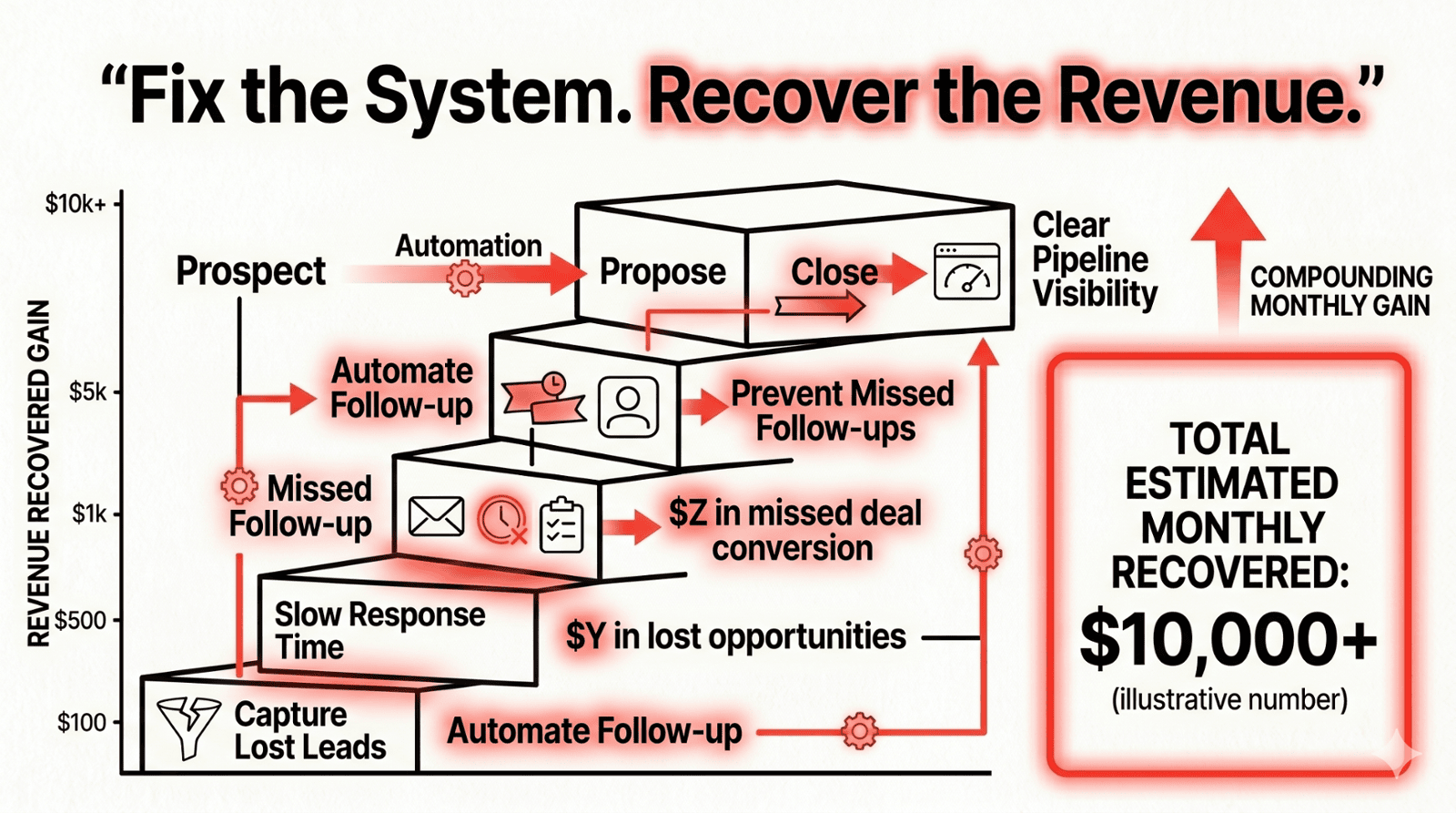
A mid tier Zoho CRM licence for a 5 person Canadian sales team costs approximately $3,120 CAD per year. If that system recovers even one additional closed deal per month from improved lead capture and follow up alone, the ROI is achieved in the first week of operation.
Section 04
What the Canadian Market Is Doing Right Now
Here is something worth knowing. While you are reading this, your competitors are making decisions about their sales infrastructure. The Canadian SMB market is in the middle of a meaningful technology adoption cycle. Businesses that implemented CRM systems two or three years ago are now seeing compounding returns. Their data is cleaner, their pipelines are more predictable, and their salespeople are more productive.
Businesses that are still on spreadsheets are starting to feel the performance gap. In industries like construction, trades, professional services, and wholesale distribution, which together represent a massive share of Canadian SMB employment, the adoption of proper CRM tools is accelerating. The business owners who move now are building a structural sales advantage that will be difficult for later adopters to close.
The data residency question is also becoming more pressing for Canadian businesses. With Zoho's launch of dedicated Canadian data centres in 2025, Canadian businesses can now store all customer data within Canada. This is relevant for businesses in regulated industries or those with clients who have specific data sovereignty requirements.
Section 05
What the First 90 Days on a CRM Actually Looks Like
One of the most common objections to CRM adoption is the belief that implementation is a long, painful, disruptive process. For a well run implementation by an experienced Zoho partner, this is not the case. Here is what a realistic 90 day timeline looks like for a Canadian SMB.
Days 1 to 14: Setup and Data Migration
Your existing contacts, deals, and notes are cleaned and imported into Zoho CRM. Pipelines are configured to match your actual sales process, not a generic template. Lead capture sources are integrated so every new enquiry flows directly into the system. Your team is set up with the right access levels and a customised view that matches how they work.
Days 15 to 30: Automation Configuration
Follow up workflows are built and activated. Lead assignment rules are set so every new lead is immediately routed to the right salesperson. Email templates for common communications are created. The first automated sequences, acknowledgement emails, follow up reminders, and task triggers go live. Your team starts experiencing what it feels like to have the system do the administrative work for them.
Days 31 to 60: Team Adoption and Refinement
This is the phase where the system gets refined based on how your team is actually using it. Salespeople who were sceptical start to see the value when they open Zoho's Workqueue each morning and find a prioritised list of exactly who they should be contacting that day, with full context on each conversation. Managers start using the pipeline dashboard for their Monday morning check ins instead of asking each salesperson individually.
Days 61 to 90: Reporting and Optimisation
By day 60, you have enough data to start seeing patterns. Which lead sources are converting, where deals are getting stuck, and the average time from first contact to proposal. These questions, which were previously unanswerable, now have clear data behind them. The CRM stops being a tool for tracking and starts being a tool for decision making. By the end of 90 days, most businesses report that they cannot imagine going back to how they operated before.
Section 06
Why a Certified Zoho Partner Changes the Outcome
The difference between a CRM that sits unused after three months and one that transforms your sales operation is almost never the technology. It is the implementation.
Working with a certified Zoho Premium Partner means your system is built around your specific sales process, your team size, your industry, and your growth goals, not configured from a generic template. It means your data migration is handled without loss. It means your workflows are built correctly the first time. And it means you have an expert to call when something needs to change as your business evolves.
As a certified Zoho Premium Partner serving Canadian businesses, we have implemented Zoho CRM for businesses in trades, professional services, wholesale distribution, retail, manufacturing, and more. We understand the specific challenges of the Canadian market, including CASL compliance, GST and HST workflows, and Canadian data residency, and we build them into every implementation from the start.
Final Thoughts
Not having a CRM is not a neutral position. It is an active choice to accept the revenue leaks, the missed follow ups, the lost context, and the administrative overhead that come with managing a sales process manually, in a market where your competitors are increasingly choosing not to.
The math on CRM adoption for Canadian small businesses is not complicated. The cost of a well implemented system is a fraction of the revenue it recovers in the first month alone. The question is not whether you can afford a CRM. It is whether you can afford to keep operating without one.
We are here when you are ready.
Ready to Stop the Leak?
Book Your Free CRM Readiness Assessment
We offer a free 45 minute CRM readiness assessment for Canadian businesses. No pressure. No sales pitch. Just an honest conversation about where your sales process is today and what it would take to fix the gaps.